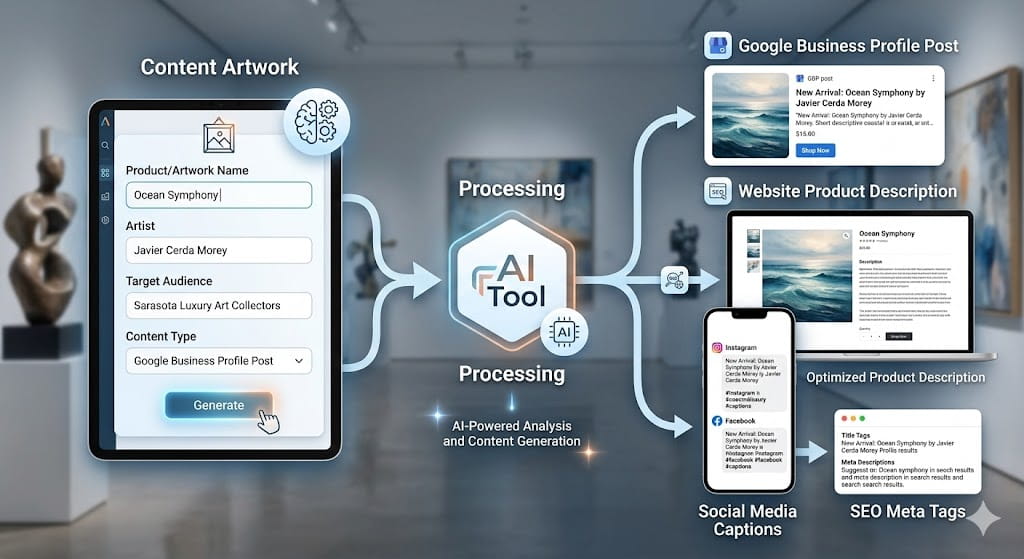
If you’re an SEO manager onboarding a new client, one of the biggest challenges is the sheer volume of upfront work — researching their brand, identifying keyword opportunities, planning content, and building a repeatable system. Jasper AI is designed to speed up exactly this process. Here’s a practical breakdown of how it works at each stage.
1. Starting with Client Research
Before you write a single word of content, you need to understand who your client is. Jasper’s Research Agent cuts this phase from days to minutes by doing three things automatically.
First, it scans the client’s website to understand their niche, services, and overall tone of voice. Second, it compares their site against competitors to surface content gaps — topics their rivals are ranking for that the client hasn’t touched yet. Third, it builds a Brand Voice Profile by analyzing the client’s best-performing pages, so any content you create later actually sounds like the brand, not a generic AI-written article.
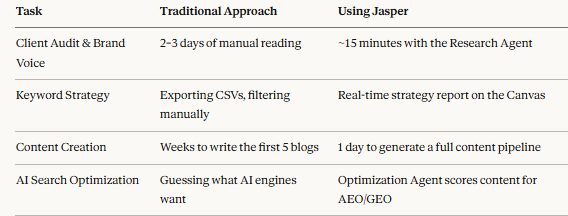
This alone can save an SEO manager two to three days of manual reading and note-taking.
2. Building a Data-Driven Keyword Strategy
Jasper integrates directly with Semrush and Surfer SEO, which means your keyword research isn’t based on guesswork — it’s pulled from live search data.
Through the Optimization Agent, you can ask Jasper something like: “Identify 10 high-volume, low-competition keywords for an art gallery in Sarasota.” It will return a strategy report that maps each keyword to its search intent — whether the user is looking for information, ready to buy, or comparing options — and recommends the specific content format best suited for that intent, such as a how-to guide, a product page, or a listicle.
It also performs SERP analysis, examining what’s currently ranking on Page 1 and generating a Content Brief that tells you exactly how many words, headings, and images your piece needs to be competitive.
3. Creating a Repeatable Content Pipeline
For any new client, you want a system — not a one-off sprint. Jasper handles this through two features: Campaigns and Jasper Grid.
With Campaigns, you enter one core goal (for example, “Promote Javier Cerda Morey’s ocean art collection”) and Jasper generates an entire month’s worth of content ideas — SEO blog titles, meta descriptions, and even Google Business Profile update copy.
With Jasper Grid, if your client has a large inventory like hundreds of product listings or artworks, you can generate or refresh SEO descriptions for all of them in bulk. Every single product page gets properly optimized without you manually writing each one.
4. Optimizing for AI-Powered Search (AEO & GEO)
In 2026, showing up in Google’s traditional blue links is only part of the picture. Your content also needs to appear in AI-generated summaries from tools like Gemini and ChatGPT Search. Jasper addresses this in two ways.
AEO (Answer Engine Optimization) focuses on structuring your content with FAQ schema and clear, concise answer blocks that AI engines are more likely to pull into their featured responses.
GEO (Generative Engine Optimization) is about building the E-E-A-T signals — Experience, Expertise, Authoritativeness, and Trustworthiness — that AI tools look for when deciding which sources to cite as credible.
Traditional Planning vs. Using Jasper: A Quick Comparison
A Practical Tip for Niche Clients (Like an Art Gallery)
If you’re working with a local or niche business, use the Optimization Agent specifically for your Google Business Profile. A prompt like this works well:
“Write a weekly SEO post for a gallery in Nokomis targeting Sarasota art collectors, focusing on Coastal Modern keywords.”
This keeps your local SEO consistent and relevant without requiring you to brainstorm fresh content every week.
Final Thoughts
Jasper isn’t a replacement for SEO expertise — it’s a force multiplier. The strategy, the judgment calls, and the client relationships still come from you. But for the repetitive, time-consuming parts of building an SEO system from scratch, Jasper can compress weeks of work into a single day, which is especially valuable when you’re onboarding multiple clients at once.
Jasper does not offer a permanent free plan, but it provides a free trial so you can test the platform before committing. Paid plans start from around $39 per month for individuals, with higher-tier plans available for teams and agencies that need advanced features like the Research Agent and Jasper Grid.
Basic SEO knowledge helps you get more out of Jasper, but it is not required to get started. Jasper guides you through keyword selection, content briefs, and optimization suggestions. That said, the more you understand concepts like search intent and E-E-A-T, the better your results will be because you’ll know how to ask Jasper the right questions.
Jasper Grid is a bulk content generation feature designed for clients with large inventories such as e-commerce stores, art galleries, or real estate listings. Instead of writing descriptions one by one, you upload your data and Jasper generates optimized content for all of them simultaneously — saving hours of repetitive work.
No. Jasper speeds up research, writing, and optimization tasks, but it still requires a skilled SEO professional to direct it, review its output, and make strategic decisions. Think of it as a highly capable assistant that removes time-consuming tasks so the SEO Manager can focus on strategy and client relationships.
Using traditional methods, a full client audit, keyword research, and initial content plan can take one to three weeks. With Jasper’s Research Agent and Optimization Agent, the same process can be completed in one to two days — making it especially valuable for agencies managing multiple clients at once.